
Ladder accidents are a serious risk on construction sites throughout New York City. Workers in Manhattan, Brooklyn, Queens, the Bronx, and Staten Island regularly use extension ladders, stepladders, fixed ladders, and other equipment to reach elevated work areas. When a ladder slips, shifts, collapses, breaks, or is positioned unsafely, a worker can suffer severe injuries in seconds.
If you were injured in a ladder accident while performing construction, renovation, demolition, painting, repair, or other covered work, you may have rights beyond workers’ compensation. NYC Construction Accident Lawyers can investigate the accident, identify potentially responsible parties, and evaluate whether New York Labor Law or other legal claims may apply.
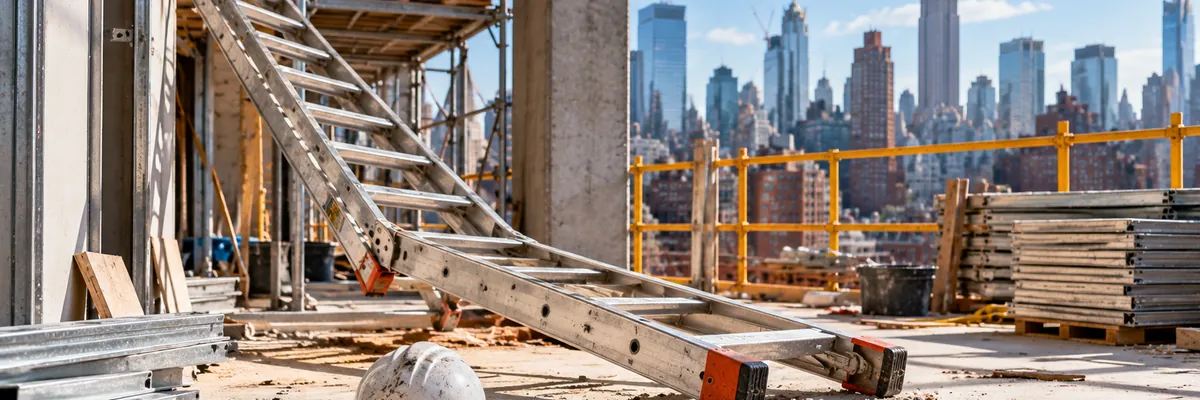
Construction ladders should be selected for the task, positioned on a stable surface, maintained in safe condition, and used with appropriate protections. A ladder accident may involve an unsecured ladder, unstable or slippery footing, damaged equipment, an unsuitable ladder type or size, missing safety features, debris around the work area, or a lack of adequate protection for elevated work.
The precise cause matters. Photographs, witness accounts, site records, safety plans, equipment information, and evidence showing how the ladder was positioned or secured can become important.
A ladder fall can cause broken bones, traumatic brain injuries, concussions, spinal injuries, herniated discs, neck and back injuries, shoulder injuries, knee and leg injuries, hand and wrist fractures, internal injuries, nerve damage, paralysis, and permanent disability.
Some workers require surgery, hospitalization, rehabilitation, or long-term treatment. Serious injuries may also prevent a worker from returning to physically demanding construction work or reduce future earning capacity.
New York Labor Law § 240(1) addresses certain elevation-related risks in specified construction activities. The statute expressly identifies ladders among the devices that covered owners, contractors, and their agents may be required to furnish or erect so that they are constructed, placed, and operated to provide proper protection.
Whether § 240(1) applies to a particular ladder accident is fact-specific. The work being performed, the elevation-related risk, the equipment provided, how the ladder failed or was used, and other circumstances can affect the legal analysis. A ladder fall does not by itself establish every element of a claim.
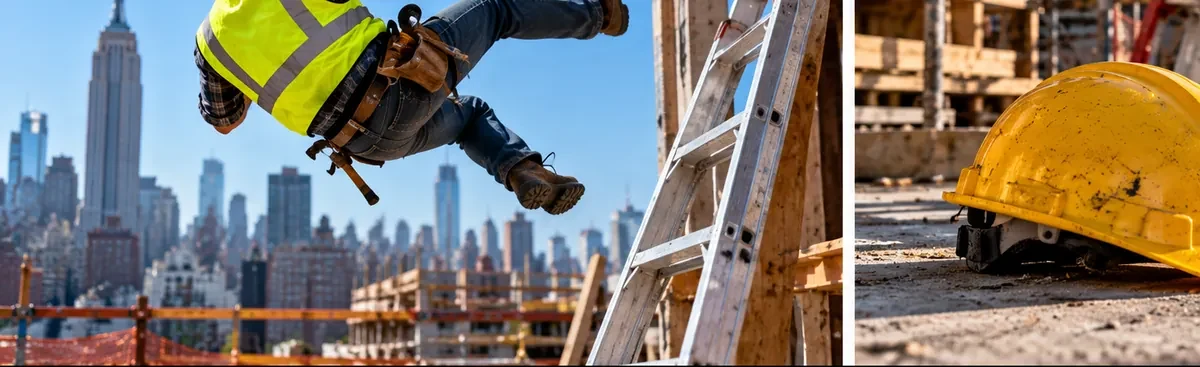
The statute identifies activities including erection, demolition, repairing, altering, painting, cleaning, and pointing of a building or structure. A worker who falls when an unsecured or inadequate ladder fails to provide proper protection during covered work may have a claim, depending on the evidence and circumstances.
An investigation should examine the task, ladder condition and setup, available safety equipment, project participants, contracts, witness accounts, and any photographs or video of the scene.
A worker injured in the course of employment may be eligible for New York workers’ compensation benefits, including medical care and wage-replacement benefits subject to the system’s rules.
Workers’ compensation is not always the only potential avenue. Depending on the project and accident, a separate third-party claim may exist against an owner, general contractor, equipment company, manufacturer, or another legally responsible party. The availability of any third-party claim depends on the facts.
Potential damages in a personal injury action can include past and future medical expenses, lost income, reduced future earning capacity, pain and suffering, rehabilitation costs, physical limitations, and other losses recognized by law.
The damages available depend on the injuries, evidence, liability, applicable law, insurance, and other case-specific circumstances. No particular result or amount can be predicted from the fact that a ladder accident occurred.
Seek appropriate medical attention and report the accident through the required workplace procedures. If it is safe and your condition permits, photograph the ladder, its position, the surrounding work area, visible defects, and any relevant safety equipment.
Preserve witness contact information, accident reports, medical records, bills, wage information, photographs, and information about the construction project and your employer. Evidence at an active worksite can change quickly because ladders may be moved, repaired, discarded, or replaced.
Before giving a detailed recorded statement to an insurer or signing settlement documents, consider obtaining legal advice about your rights and the effect of the requested statement or release.
The New York City Department of Buildings regulates construction and demolition activity and identifies Chapter 33 of the NYC Construction Codes as addressing safeguards during construction or demolition. Depending on the accident, DOB records, inspection materials, site-safety documentation, incident reports, photographs, and project records may be relevant.
State and federal safety requirements may also be relevant to the investigation depending on the work, equipment, and circumstances.
Ladder accident cases can involve multiple contractors, insurers, specialized Labor Law questions, and rapidly changing worksite evidence. A lawyer can investigate independently rather than relying solely on the conclusions of a contractor or insurer.
Legal work may include identifying project participants, preserving evidence, obtaining construction and safety records, interviewing witnesses, reviewing the ladder and other equipment, evaluating applicable statutes and regulations, documenting damages, and communicating with insurers.
A ladder fall can have lasting medical and financial consequences. If you were injured while working at a New York City construction site, workers’ compensation may be one part of the analysis, but other claims may also be available depending on the project and the parties involved.
NYC Construction Accident Lawyers can review a ladder accident in Manhattan, Brooklyn, Queens, the Bronx, or Staten Island and explain the legal options supported by the facts. Contact the firm for a confidential case evaluation.